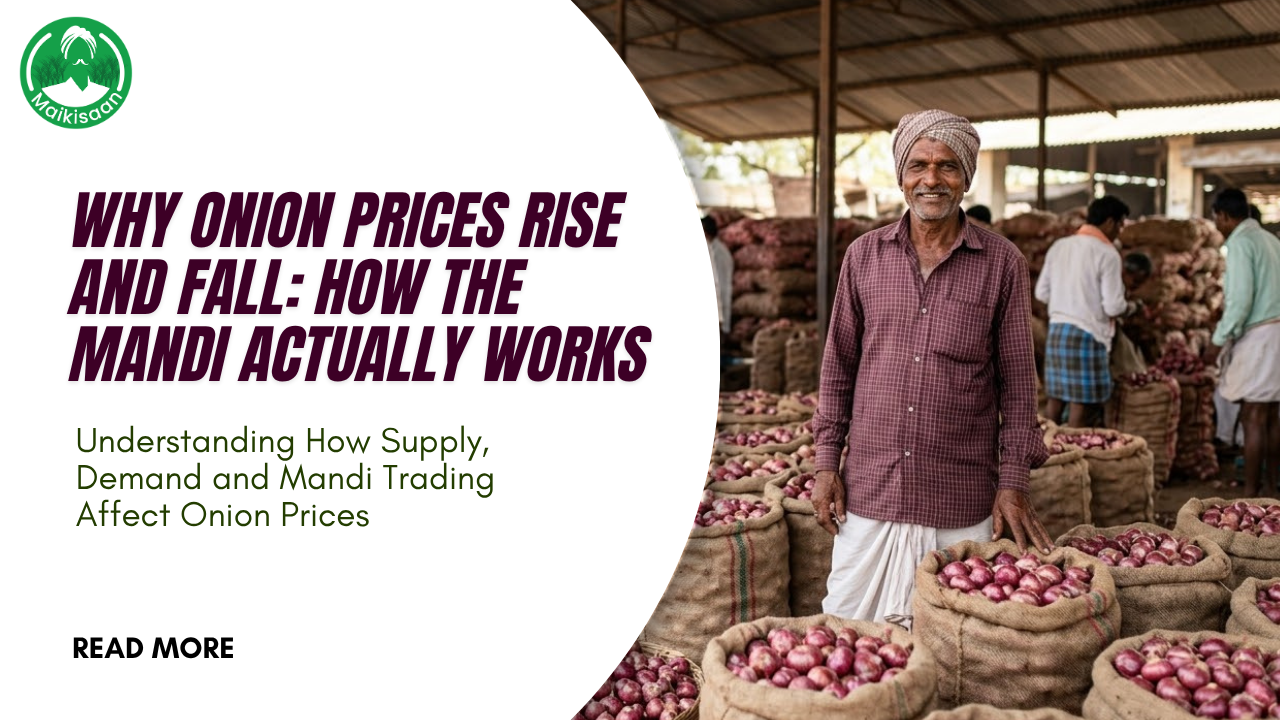
Onion prices depend on four main factors: daily arrivals at mandis, available stored stock, government export policies, and onion quality. Daily arrivals and export decisions can cause sudden price changes, while stored stock influences prices over the longer term. Onion size, freshness, and overall quality also determine the price farmers receive.
Live mandi rates for Onion in Lasalgaon are updated every morning. Check today's rate →
Arrivals are the fastest mover
One of the biggest factors affecting daily onion prices is the quantity of onions arriving at the mandi. Since onions are perishable and require proper handling and storage, farmers often need to sell their produce soon after harvesting. When farmers from multiple districts bring large quantities to the mandi at the same time, supply increases and prices can fall within a few days. On the other hand, heavy rainfall, harvesting delays, or transportation disruptions can reduce arrivals, leading to lower supply and higher mandi
Stored stock sets the season
Rabi onions, harvested mainly during March and April, are stored to maintain market supply during the months when fresh arrivals are limited. In 2026, stored Rabi stocks have been running low, while the arrival of the new Kharif crop has been delayed, creating temporary supply pressure and pushing mandi prices upward. As of November 2026, fresh Kharif onion arrivals have started in Karnataka, Andhra Pradesh and Rajasthan. Arrivals from Maharashtra and other major producing regions are also expected to increase during November. The government is releasing onions from its buffer stock to improve availability and control price fluctuations. pib.gov.in+2 This seasonal cycle shows why farmers should consider storage costs, onion quality, expected arrivals and market demand before deciding when to sell. A higher price today does not always mean better returns after storage expenses and potential losses.
Export policy can change everything overnight
Onion is an essential food item in India, so the government closely monitors its availability and prices. When domestic supplies become tight or prices rise sharply, the government can introduce export restrictions, minimum export prices or export duties to protect domestic consumers. On the other hand, removing these restrictions can make Indian onions more competitive in international markets and create additional demand for farmers' produce. As of November 2026, the 20% onion export duty has been withdrawn, effective from 1 April 2025. The government has also removed the earlier minimum export price requirement. However, export policies can change depending on domestic supply, market arrivals and price conditions. Press Information Bureau+2 For farmers, this means export policy is an important factor to watch. A change in government decisions can influence export demand, domestic supply and mandi prices, sometimes within a short period.
Quality decides where you sit in the range
Onion mandi prices are not the same for every farmer. Even on the same day, prices can vary depending on the quality of the produce. Well-graded onions with uniform size, good colour, dry outer skin and proper curing usually receive better prices. On the other hand, mixed-size onions, damaged bulbs, excess moisture and poor-quality produce may sell at lower rates. Farmers cannot control daily market prices, but they can improve the quality of their produce before bringing it to the mandi. Proper sorting, grading, curing and removing damaged onions can help farmers get better prices. Separating onions according to size and quality before transportation is a simple step that can improve returns and reduce avoidable losses
| Driver | Speed | Direction |
|---|---|---|
| Fresh Kharif arrivals increasing | Days to weeks | More arrivals, downward price pressure |
| Government buffer stock releases | Days to weeks | Increased supply, helps moderate prices |
| Stored Rabi onion availability | Over months | More stock, supports supply and price stability |
| Onion export demand | Weeks | Higher export demand can support domestic prices |
| Rainfall or transport disruption | Days to weeks | Delayed arrivals can push prices upward |
| Onion quality and grading | Same day | Better quality generally fetches higher prices |
Frequently asked questions
- Can I predict next month's onion price?
- Farmers do not need to guess next month's onion prices. By tracking mandi arrivals, historical rates, weather forecasts, stored stock and government policies, they can make more informed selling decisions. Regular market monitoring helps farmers understand whether prices are likely to rise, fall or remain stable.
- Why is my rate lower than the one reported in the news?
- The onion price reported in the news may not be the same as the price a farmer receives at the mandi. News reports often mention modal prices, average prices or the highest rates recorded in selected markets, while an individual farmer's selling price depends on the quality, size, variety and quantity of onions brought to the mandi.