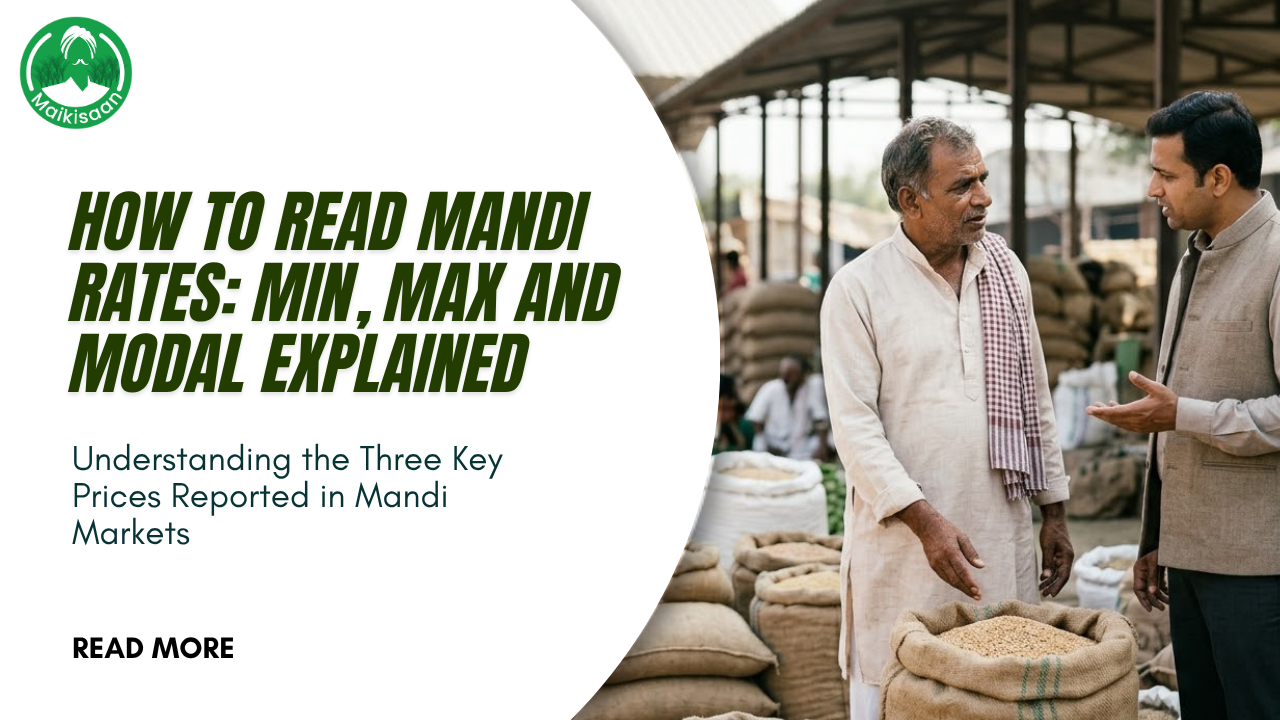
Every mandi reports a minimum, a maximum and a modal price. The minimum is what the poorest lots fetched, the maximum what the best fetched, and the modal is where most trade actually happened. Plan against the modal. The gap between minimum and maximum tells you how much quality mattered that day.
What you need
- Today's rate for your commodity and market
- The same rate for one or two nearby markets
- An honest assessment of your own produce quality
- Total time
- 10 minutes
- 1
Find your commodity and market
Start with the market you would actually sell in, not the largest one in the state. A rate you cannot reach is not a rate available to you.
- 2
Read the modal price first
This is where most of the day's trade happened, so it is the most realistic expectation. The maximum is achievable only if your lot is genuinely among the best on the day.
- 3
Look at the gap between minimum and maximum
A narrow gap means quality barely mattered that day. A wide gap means it mattered a great deal, and sorting before you load is likely to pay for itself several times over.
- 4
Compare two or three markets
Rates differ between markets because arrivals are local. Work out the difference per quintal against your transport cost before deciding to move the load further.
- 5
Check the direction, not just today
One day's rate tells you little. Looking at the last week or two shows whether the market is firming or softening, which is what actually matters if you have any choice about when to sell.
Frequently asked questions
- Why is my rate below the modal price?
- Usually quality, moisture or grading. The modal assumes ordinary trade quality; anything below that prices lower.
- Which market's rate should I trust?
- The one you can actually reach, plus the large benchmark market for direction. Use the benchmark to judge whether your local offer is fair.