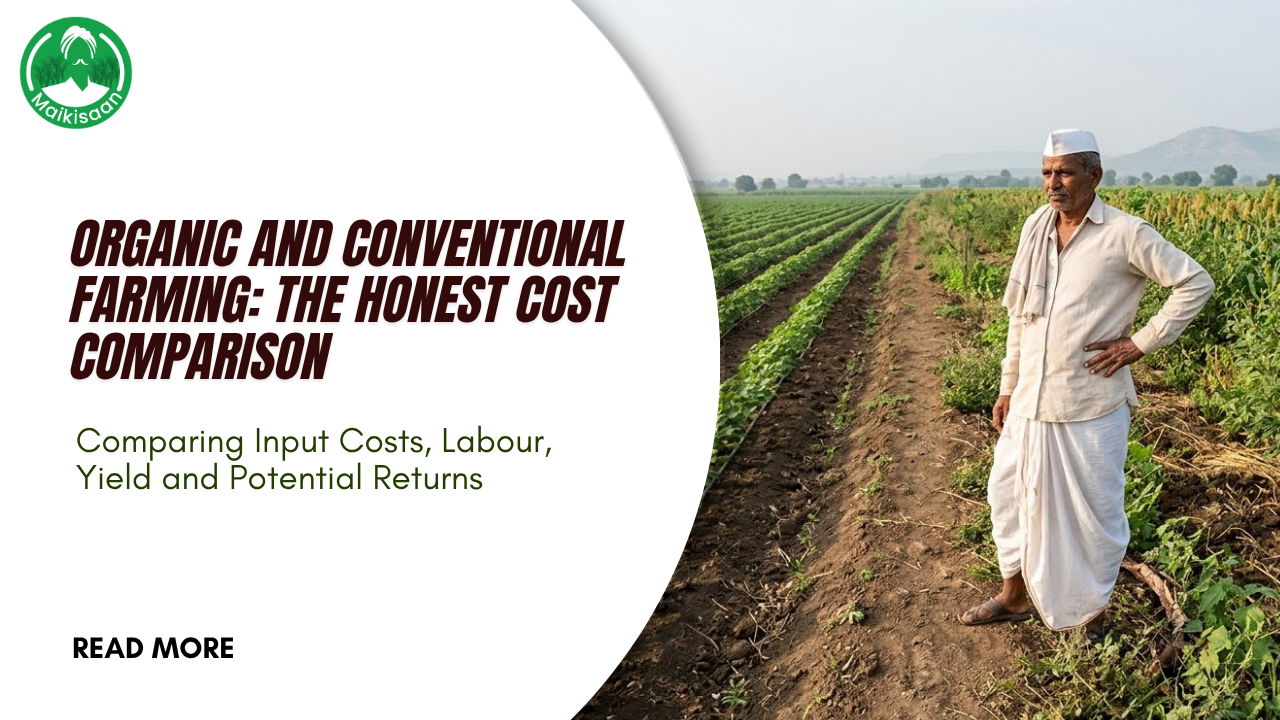
Organic farming usually lowers input cost and lowers yield, at least at first. Whether it pays depends entirely on whether you can reach a buyer who pays a premium, and that generally requires certification. Without a premium market, organic is a lower-cost, lower-output version of the same business.
The transition period is the hard part
Land moving from conventional to certified organic goes through a conversion period during which you follow organic practice but cannot sell at organic prices. Yields often dip while soil biology adjusts. Farmers who plan for this survive it; farmers who do not often revert halfway.
Certification is what creates the premium
The price premium exists because a buyer can prove the claim to their own customer. Without certification you are selling conventionally grown produce at conventional rates while carrying organic costs. Certification has a cost and a paperwork burden, and it is the thing that makes the model work.
Where the cost actually moves
Purchased fertiliser and pesticide fall, sometimes sharply. Labour usually rises, because weed and pest management becomes more manual. On-farm inputs like compost take time and effort rather than cash. The net effect varies enormously by crop and by how much labour you have available.
Decide on the market first
The sequence that fails is converting first and looking for a buyer afterwards. The sequence that works is establishing that a premium buyer exists and will take your volume, then converting toward what they need. Talk to buyers before you change your practice.
| Conventional | Organic | |
|---|---|---|
| Purchased inputs | Higher | Lower |
| Labour | Lower | Usually higher |
| Yield | Higher | Often lower, especially early |
| Price received | Market rate | Premium, if certified and sold to the right buyer |
| Certification | Not needed | Needed for the premium |
| Transition | None | A conversion period with organic costs and conventional prices |
Frequently asked questions
- Can I sell as organic without certification?
- You cannot make a certified organic claim, and most premium buyers require the certificate. Local direct sales sometimes work on trust, but not at scale.
- Is organic always more profitable?
- No. It is more profitable when a premium market is genuinely reachable. Without one it is simply a different cost structure.