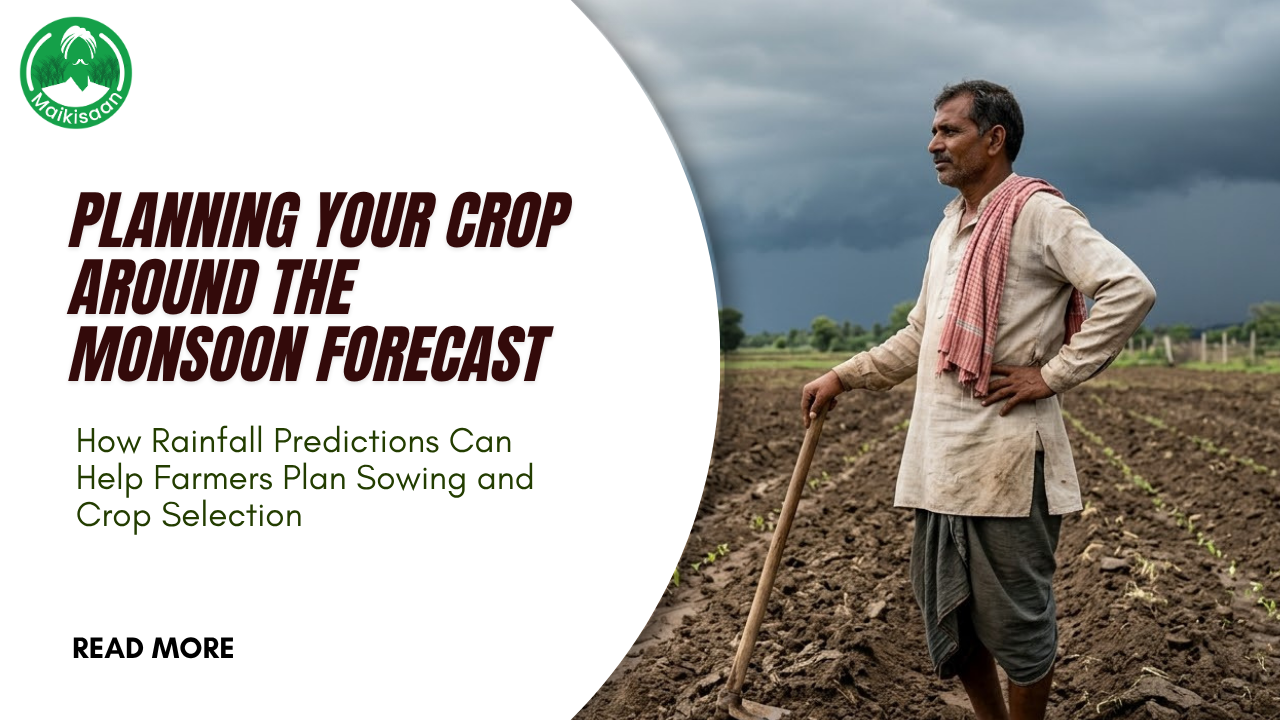
Seasonal rainfall forecasts give a probability, not a certainty, and they describe large regions rather than your field. Use them to shift the balance of what you plant rather than to bet the whole season. Spreading risk across crops with different water needs is more reliable than trying to predict the rain.
What a forecast can and cannot tell you
A seasonal outlook describes the likely total rainfall over a large area across a long period. It cannot tell you whether your particular field gets rain in the week you need it. Treat it as a tilt in the odds, not as information about your own farm.
Distribution matters more than total
A normal total delivered in a few heavy spells can be worse for a crop than a slightly lower total spread evenly. Two seasons with the same rainfall figure can produce completely different outcomes, which is why the headline number alone is a poor planning tool.
Spread risk across crops
Planting everything on the assumption of a good monsoon works well in a good year and badly in a poor one. A mix that includes something less water-dependent limits the damage when the season disappoints, at the cost of some upside when it does not.
Know your own field's history
Your own record of what happened in past seasons on your own land is more useful than any regional forecast. Which parts drain well, which crops survived a dry spell, when the water source ran short. That knowledge is specific in a way a forecast never is.
| Forecast says | Reasonable response | Unreasonable response |
|---|---|---|
| Above normal rain likely | Tilt toward water-responsive crops | Plant only water-hungry crops |
| Below normal rain likely | Increase the share of hardier crops | Abandon planting |
| Normal rain likely | Follow your usual plan | Assume the season is guaranteed |
| Anything at all | Keep a mix | Bet everything on one outcome |
Frequently asked questions
- How accurate are seasonal forecasts?
- They are more reliable about broad regional totals than about local timing. Useful for tilting a plan, not for scheduling field operations.
- Should I delay sowing if a poor monsoon is forecast?
- Sowing decisions should follow actual conditions in your field, not a seasonal outlook issued months earlier.