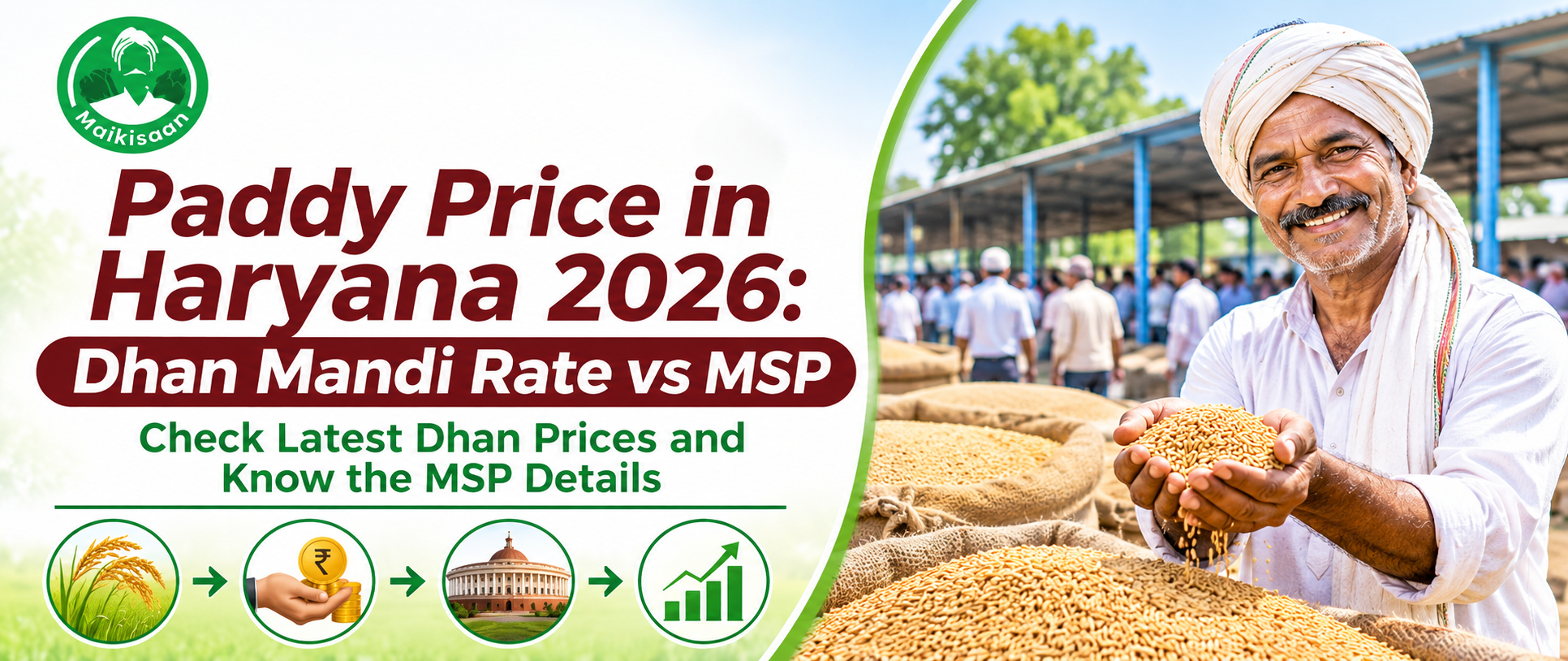
The paddy MSP in Haryana for the 2026–27 Kharif Marketing Season is ₹2,441 per quintal for Common Paddy and ₹2,461 for Grade A. Actual Dhan mandi rates vary by variety, grain quality, moisture and market demand. Farmers should compare the latest mandi prices with MSP before selling.
Paddy Price in Haryana 2026: Latest Dhan Mandi Rate Overview
Paddy prices in Haryana can vary from one mandi to another depending on the variety, grain quality, moisture content, local arrivals and demand from buyers. Therefore, the price received by a farmer in Karnal may be different from the price offered in Kaithal, Kurukshetra, Ambala or other mandis. For the Kharif Marketing Season 2026–27, the Government of India fixed the Minimum Support Price (MSP) at ₹2,441 per quintal for Common Paddy and ₹2,461 per quintal for Grade A Paddy. These are the official support prices for eligible paddy procured under the government procurement system. They should not be confused with the daily open-market mandi rate. Press Information Bureau+1 Farmers should check the latest rate for their specific mandi before taking their crop for sale. A quoted mandi price may represent a particular variety or quality, so it is important to confirm the rate and applicable deductions directly with the mandi or an authorised buyer.
Paddy MSP Rate in Haryana 2026–27
The Minimum Support Price is the price announced by the Central Government for specified agricultural crops before the marketing season. It is intended to provide farmers with a support price when their produce is purchased under the applicable government procurement arrangements. For the 2026–27 Kharif Marketing Season, the announced paddy MSP rates are: - Common Paddy: ₹2,441 per quintal. - Grade A Paddy: ₹2,461 per quintal. The MSP announcement was made on 13 May 2026. Compared with the previous season, the Common Paddy MSP increased from ₹2,369 to ₹2,441 per quintal, while the Grade A MSP increased from ₹2,389 to ₹2,461 per quintal. Press Information Bureau+1 Farmers should remember that MSP is not automatically the price offered by every private trader. The actual transaction price in an open mandi can be higher or lower depending on market conditions. Government procurement at MSP is subject to the applicable procurement rules and quality specifications.
Difference Between Dhan Mandi Rate and MSP
Dhan mandi rate and MSP are two different price concepts. Understanding the difference can help farmers make better selling decisions. Dhan mandi rate is the price at which paddy is traded in a particular agricultural market. It can change daily according to arrivals, demand, quality, variety and the buying activity of traders and millers. MSP, on the other hand, is the support price announced by the Government of India for the crop and marketing season. In Haryana, eligible paddy is purchased through the notified government procurement system in accordance with the applicable rules. For example, if a trader offers a price above the MSP, a farmer may compare that offer with the government procurement option. If a private offer is below MSP, the farmer should check whether the crop meets procurement requirements and whether government procurement is available at the designated centre. Before deciding where to sell, farmers should compare the offered price, grain quality requirements, weighing process, payment terms and transportation expenses. The highest quoted price may not always mean the highest final amount received after costs.
Haryana Paddy Procurement 2026: Dates and Government Arrangements
For the 2026–27 Kharif Marketing Season, paddy procurement in Haryana began on 29 September 2026, earlier than the originally scheduled date of 1 October. The announced procurement period continued until 15 November 2026. NAYA HARYANA+1 The Haryana Government arranged procurement through designated mandis and procurement centres. The agencies involved included the Food, Civil Supplies and Consumer Affairs Department, HAFED and the Haryana State Warehousing Corporation. The state also reported the use of geo-fencing facilities at procurement centres to support monitoring and transparency. NAYA HARYANA+1 Since the announced procurement period ended on 15 November, farmers checking prices after that date should confirm whether any procurement activity or extension applies to their particular mandi. They should not assume that regular government procurement is still operating at every centre.
How Farmers Can Sell Paddy at MSP in Haryana
Farmers planning to sell paddy through the government procurement system should check the latest instructions issued by the Haryana Government and the relevant mandi or procurement centre. Haryana uses the Meri Fasal Mera Byora (MFMB) and e-Kharid systems as part of its crop registration and procurement process. The e-Kharid system supports activities such as farmer registration, sale of agricultural produce and payment processing. India Farmers should take these practical steps: - Check that their crop and land-related details are correctly registered on the applicable government portal. - Confirm the designated mandi or procurement centre for their area. - Check the procurement schedule before transporting the harvested crop. - Keep the documents and registration details required by the local procurement authorities ready. - Follow the mandi instructions for entry, weighing, quality checks and sale. - Keep the sale receipt or transaction details for future reference. Farmers should confirm the current document requirements and registration status through the official Haryana portal or their local mandi office. Requirements and procedures can change, so it is better to rely on the latest official instructions rather than an old checklist.
Factors That Affect Paddy Prices in Haryana Mandis
Even during the same procurement season, paddy prices may differ between mandis. The price depends on several market and crop-related factors. Paddy variety: Different varieties may attract different prices depending on buyer demand, milling requirements and local trading preferences. Moisture content: Paddy with excess moisture may not meet the applicable procurement or buyer specifications. Farmers should dry and store harvested grain properly and check the permitted moisture limits before bringing it to the mandi. Grain quality: Cleanliness, damaged grains, immature grains and other quality characteristics can influence whether the produce meets procurement specifications or attracts a particular market price. Mandi arrivals: When a large quantity of paddy arrives in a mandi at the same time, local supply conditions can affect the price offered by buyers. Demand from traders and rice mills: Buying activity from traders and millers can influence open-market rates. Demand may differ by variety and quality. Transportation and handling costs: The distance to the mandi, loading, unloading and other selling expenses can affect the farmer’s final return. Farmers should therefore compare prices for the same variety and quality rather than relying only on a general Haryana paddy price. They should also confirm whether the quoted amount is the gross price or the final amount payable after any applicable charges.
How to Check the Latest Haryana Dhan Mandi Rate
Paddy mandi rates can change, so farmers should check the latest available information on the day they plan to sell. A price seen in an old news report or a previous day's market update may no longer be valid. To check the rate, farmers can: - Contact their nearest regulated mandi or market committee. - Ask local traders or authorised buyers for the current offer for their paddy variety. - Check official market-price information where data for the relevant mandi and commodity are available. - Compare the quoted price with the applicable MSP for the 2026–27 season. - Confirm the date of the rate, the variety, the quality and the unit of measurement.
| Particulars | Common Paddy | Grade A Paddy |
|---|---|---|
| Government MSP 2026–27 | ₹2,441/quintal | ₹2,461/quintal |
| Previous season MSP 2025–26 | ₹2,369/quintal | ₹2,389/quintal |
| MSP increase | ₹72/quintal | ₹72/quintal |
Frequently asked questions
- What is the paddy MSP in Haryana for 2026–27?
- The Government of India has fixed the paddy MSP for the 2026–27 Kharif Marketing Season at ₹2,441 per quintal for Common Paddy and ₹2,461 per quintal for Grade A Paddy.
- What is the difference between paddy mandi price and MSP?
- Paddy mandi price is the rate offered by buyers in a particular mandi, while MSP is the minimum support price announced by the government. Mandi prices can change depending on variety, quality, demand and market arrivals.
- What was the previous year's paddy MSP in Haryana?
- For the 2025–26 Kharif Marketing Season, the MSP was ₹2,369 per quintal for Common Paddy and ₹2,389 per quintal for Grade A Paddy.
- How much did the paddy MSP increase in 2026–27?
- The MSP increased by ₹72 per quintal for both Common Paddy and Grade A Paddy compared with the 2025–26 season.
- When did paddy procurement start in Haryana in 2026?
- Paddy procurement in Haryana started on 29 September 2026. The announced procurement period continued until 15 November 2026.
- Where can farmers sell paddy at MSP in Haryana?
- Farmers can sell eligible paddy at designated government procurement mandis and centres, subject to registration, procurement schedules and applicable quality specifications.
- How can farmers register for paddy procurement in Haryana?
- Farmers can use the Haryana government's Meri Fasal Mera Byora and e-Kharid systems for crop registration and procurement-related services. They should check their registration details and current requirements on the official
Read next
- Get the latest agricultural news, farming updates and useful information for farmers.
- Check the latest mandi prices of agricultural commodities.
- Check Haryana paddy mandi price updates.
- Read the latest agriculture-related news, updates and informative articles.