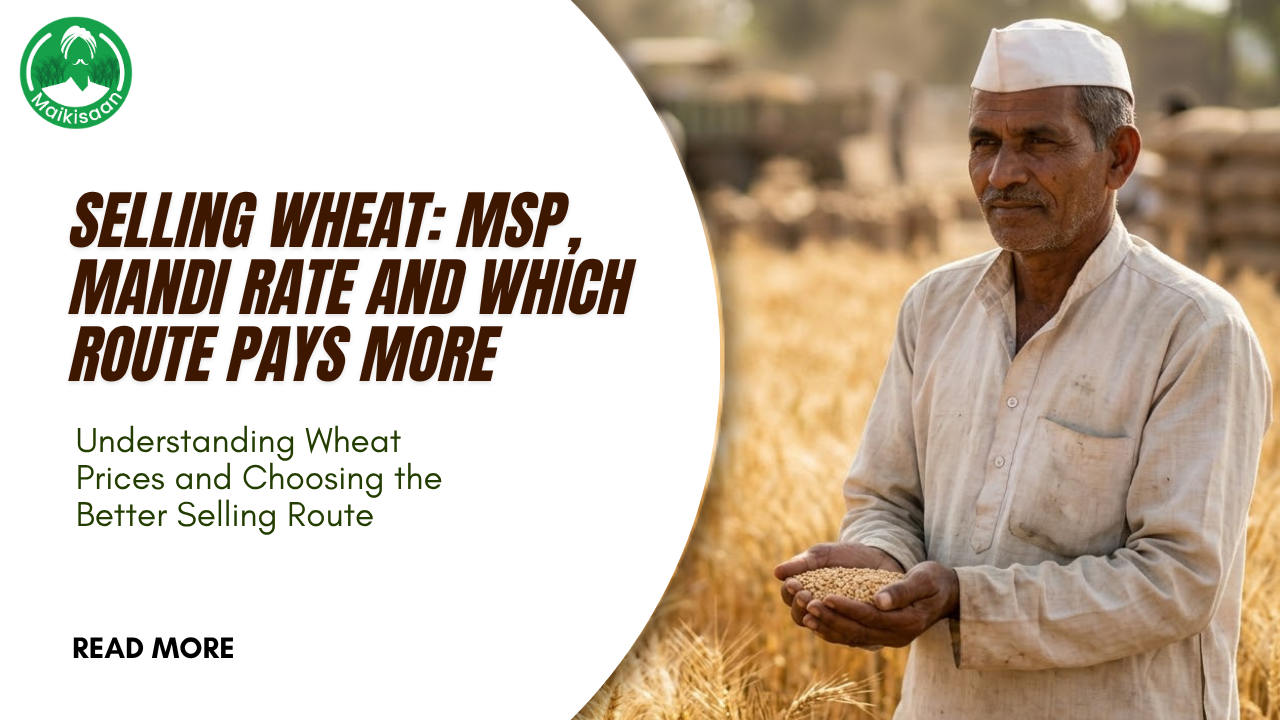
Wheat has two selling routes: government procurement at the announced minimum support price, or the open mandi. MSP guarantees a floor but requires registration, a moisture and quality check, and often a wait for payment. The open mandi pays immediately and can pay above MSP when demand is strong. Which is better depends on your quality, your cash needs and what the local rate is doing.
Live mandi rates for Wheat in markets across India are updated every morning. Check today's rate →
What MSP actually guarantees
MSP is a floor price the government commits to pay at its procurement centres. It is not a market price and it does not apply to a private trader. To get it you must sell at a designated centre, usually after registering, and your grain must pass the quality specification for moisture and foreign matter. If it fails, you are back in the open market with a load already trucked to the wrong place.
When the open mandi pays more
In years when supply is tight or private demand is strong, mandi rates run above MSP and selling privately is straightforward arithmetic. In surplus years the mandi rate can sit below MSP, and procurement becomes the better option even with the paperwork. The only way to know is to check your local modal rate against the announced MSP before you decide where to take the load.
Moisture is the thing that costs most farmers money
Both routes penalise moisture, and the open market penalises it harder because the buyer is pricing in their own storage risk. Grain that is properly dried before sale avoids a deduction that can wipe out any rate advantage you were chasing. This is the single cheapest improvement available to most wheat sellers.
Payment timing is part of the price
A rate is not just a number, it is a number plus a date. Procurement payment can take days or weeks depending on the state and the season. A trader paying slightly less today may be worth more than a higher rate paid in three weeks, particularly if you have an input bill due. Factor this in rather than comparing rates alone.
| MSP procurement | Open mandi | |
|---|---|---|
| Price floor | Guaranteed | None |
| Can exceed MSP | No | Yes, in tight years |
| Quality check | Strict specification | Priced by the buyer |
| Registration | Usually required | Not required |
| Payment | Can take days or weeks | Usually immediate |
| Best when | Mandi rate is below MSP | Mandi rate is above MSP |
Frequently asked questions
- Is MSP available for every farmer?
- Procurement centres and registration rules vary by state and season. Check with your local agriculture office what is operating in your district this year.
- Why was a deduction applied to my wheat?
- Most deductions are for moisture above specification, foreign matter, or shrivelled grain. Drying and cleaning before sale usually costs less than the deduction.